
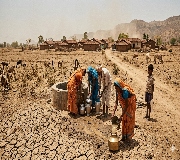
Global Warming in India : Have you noticed that summers are getting longer? That rains are arriving late — or not arriving at all in some places? That winters are becoming shorter and milder?
If you live in India, you have probably felt all of this. And you are not imagining it.
Our planet is getting hotter. Scientists call this global warming. And India — with its 1.4 billion people, its farmers, its coastlines, and its Himalayan rivers – is being affected in ways that can no longer be ignored. Read more articles like this to go Postvaani.com
What Is Global Warming, Simply Put?
Global Warming in India : When we burn coal, petrol, or wood, gases like carbon dioxide (CO₂) are released into the air. These gases act like a blanket around the Earth. They trap the sun’s heat and stop it from escaping back into space. Over time, the Earth gets warmer.
This warming affects everything — the weather, the oceans, the glaciers, the seasons, and even the food we eat.
India is not the only country being affected. But because of its size, its geography, and the millions of people who depend on farming and nature, the impact here is especially serious.
Global Warming in India : What Is Happening in India Right Now?
The numbers tell a clear story. India’s average temperature has risen by about 0.7°C over the last hundred years. That may not sound like much. But in the world of climate, even half a degree matters enormously.
Global Warming in India : In 2024, large parts of North India recorded temperatures above 45°C in May and June. Cities like Delhi, Jaipur, and Lucknow saw heatwave alerts for days at a stretch. Schools were shut. People were asked to stay indoors. Hospitals reported a rise in heatstroke cases.
In Rajasthan, the desert town of Phalodi – which already holds India’s all-time heat record of 51°C — is seeing dangerous heat arrive earlier every year.
Meanwhile, in the Northeast, Assam was hit by severe floods in 2023 and 2024. Thousands of families were displaced. Crops were destroyed. The Kaziranga National Park — home to the one-horned rhino — was submerged for weeks.
These are not isolated events. They are part of a pattern that is being repeated, year after year, across the country.
Global Warming in India : What Is Causing This?
Fossil Fuels and Vehicles
Global Warming in India : India is the world’s third-largest emitter of greenhouse gases. A large part of this comes from burning coal in power plants, petrol in cars and trucks, and gas in factories.
Every time a vehicle is started in a crowded city like Mumbai or Delhi, a small amount of CO₂ is released. Multiply that by millions of vehicles, and the numbers add up fast.
Deforestation
Forests are nature’s air filters. They absorb CO₂ and release fresh oxygen. But in India, forests have been cut down for roads, dams, housing projects, and farmland.
When trees are removed, two things happen — less CO₂ is absorbed, and the land gets hotter. Both make global warming worse.
Agriculture
Global Warming in India : India has one of the largest cattle populations in the world. Cattle release methane — a greenhouse gas that is even more powerful than CO₂. Rice paddies also release methane in large amounts.
This does not mean farming is bad. But it does mean that farming practices need to be updated to reduce emissions wherever possible.
Rapid Urbanisation
India’s cities are growing faster than ever. More buildings mean more air conditioners. More air conditioners mean more electricity. More electricity means more coal is burned. It is a cycle that keeps feeding itself.
Cities are also significantly hotter than surrounding rural areas. This is called the urban heat island effect — and it is being experienced in almost every major Indian city today.
How Is India Being Affected?
Heat Waves Are Getting Worse
Global Warming in India : Every year, heat waves are arriving earlier and lasting longer. In April 2022, North India and Central India recorded temperatures that are normally seen only in peak summer. Wheat crops were damaged across Haryana and Punjab, affecting food production.
Outdoor workers — construction labourers, farmers, street vendors — are the most exposed. Many of them have no choice but to work in the heat.
Monsoon Is Becoming Unpredictable
India’s farmers have depended on the monsoon for thousands of years. But the monsoon is now behaving differently.
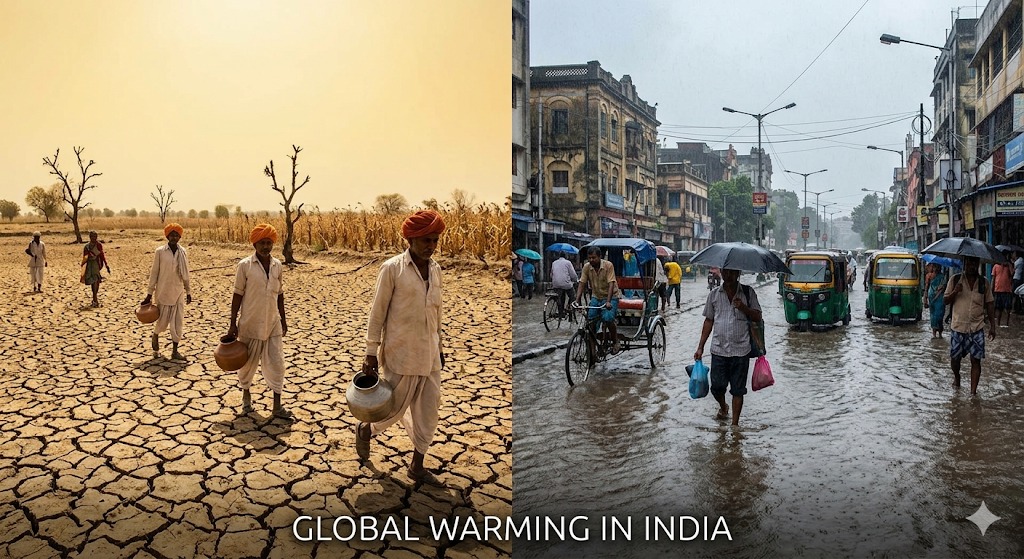
In 2023, Himachal Pradesh and Uttarakhand were hit by extreme cloudbursts. Entire villages were washed away. Roads and bridges were destroyed. At the same time, parts of Karnataka, Maharashtra, and Tamil Nadu reported drought conditions — their reservoirs nearly empty, their soil cracked and dry.
Too much water in one place. Too little in another. This is what climate change looks like on the ground.
Glaciers Are Melting
The Himalayan glaciers are the source of water for rivers like the Ganga, Yamuna, Indus, and Brahmaputra. Hundreds of millions of people depend on these rivers for drinking water, farming, and electricity.
But these glaciers are melting — and they are melting fast. Studies have shown that Himalayan glaciers are retreating at a rate faster than the global average. If this continues, water availability in North India could become a serious crisis within the next few decades.
Sea Levels Are Rising
India has a coastline of more than 7,500 kilometres. Cities like Mumbai, Chennai, and Kochi are located right on the edge of the sea.
As global temperatures rise, polar ice melts, and sea levels go up. Mumbai already experiences severe flooding during monsoon season. Some areas of the city face the risk of being permanently flooded in the future if nothing changes.
In the Sundarbans — the delta region shared by West Bengal and Bangladesh — rising sea levels are already swallowing islands. Entire fishing communities have been displaced.
Air Pollution
Global warming in India and air pollution go hand in hand. Every winter, Delhi is covered in a thick layer of smog. Vehicle exhaust, factory emissions, and the burning of crop stubble in Punjab and Haryana combine to create a toxic mix.
In 2024, Delhi recorded some of the worst air quality in the world for several days in a row. The AQI — Air Quality Index — crossed 400 in many areas. That is classified as “severe.” Breathing that air is like smoking several cigarettes a day.
Children, elderly people, and those with breathing conditions suffer the most.
What Can Be Done?
Global Warming in India : The situation is serious. But it is not hopeless.
Clean energy is the biggest solution. India has already made impressive progress here. The country is now among the top five nations in the world for installed solar energy capacity. The government has set a target of 500 gigawatts of renewable energy by 2030. Solar panels are being installed on rooftops, in fields, and on government buildings across the country.
Planting trees helps. Forests absorb CO₂ and keep local temperatures down. Community tree-planting drives, forest protection laws, and green urban planning can all make a difference.
Public transport reduces emissions. Metro rail systems in cities like Delhi, Bengaluru, Hyderabad, and Mumbai carry millions of passengers every day — and reduce the number of private vehicles on the road. Expanding these networks further would be a big step forward.
Smarter farming is needed. Farmers can be supported to use drip irrigation, grow climate-resistant crops, and avoid stubble burning. This protects both their livelihoods and the environment.
Awareness matters. When people understand climate change, Global Warming in India increasing, they make different choices — in the way they travel, the way they use electricity, and the way they vote. Schools, local communities, and the media all have a role to play in spreading this awareness.
Final Thoughts of Global Warming in India
Global warming in India is not a future problem. It is happening right now — in India’s fields, in its rivers, in its cities, and in its skies.
The farmers of Vidarbha, the fisherfolk of Kerala, the glaciers of Kedarnath, the floodplains of Assam — all of them are already living with the consequences.
But India is also a country of incredible resilience and innovation. The choices made today — by governments, by businesses, and by ordinary people — will decide what kind of country is left for the next generation.
The Earth is sending a clear message of Global Warming in India . It is time to listen.



Nice can be better