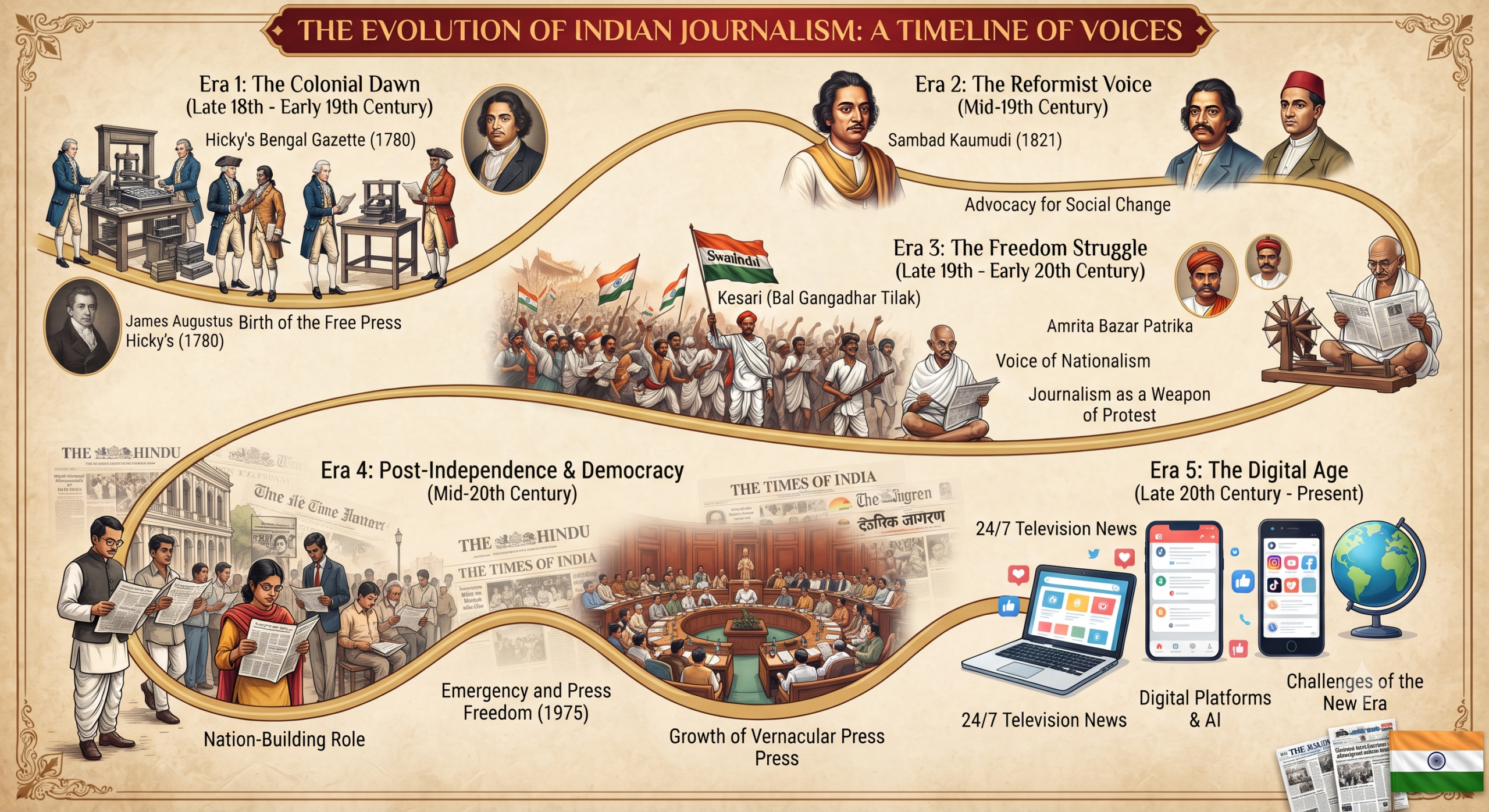
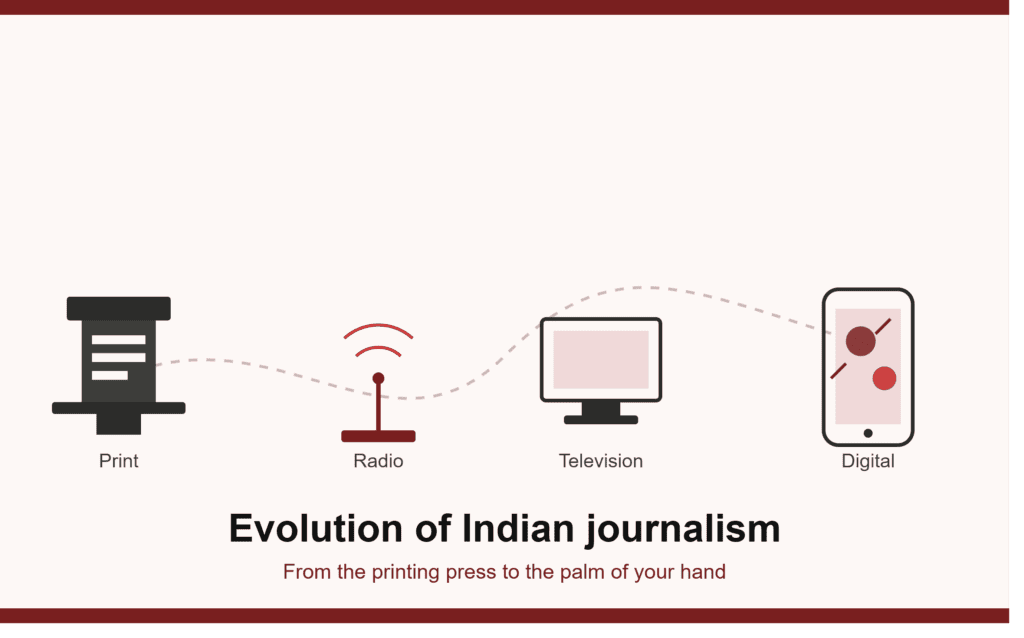
Evolution of Indian Journalism and Mass Communication : Journalism and mass communication have played an important role in the development of India. News and information have been shared through different forms of media for many years. Public awareness has been increased, and people have been connected through newspapers, radio, television, and digital platforms.
The evolution of Indian journalism and mass communication has been shaped by many social, political, and technological changes. New ways of sharing information have been introduced over time. Today, news can be received within seconds through the internet and mobile phones.
In this article, the history, growth, importance, and future of Indian journalism and mass communication will be explained in very simple English. For more informative articles like this, visit Postvaani.com and stay updated with the latest insights and news.
What Is Journalism?
Journalism is the process through which news and information are collected, verified, and shared with the public. News is reported about politics, business, education, sports, entertainment, health, science, and many other topics.
Journalists are responsible for finding facts and presenting them to the people. Information is expected to be shared in a fair, accurate, and responsible way.
Different types of journalism are practiced today. These include:
- Print journalism
- Television journalism
- Radio journalism
- Digital journalism
- Investigative journalism
- Photojournalism
Each type of journalism serves a different purpose, but all are used to inform the public.
What Is Mass Communication?
Mass communication is the process through which information is shared with a large number of people at the same time. Different media platforms are used for this purpose.
Some common forms of mass communication are:
- Newspapers
- Magazines
- Radio
- Television
- Websites
- Social media
- Podcasts
Through mass communication, news, education, entertainment, and public messages can be delivered to millions of people.
The Beginning of Journalism in India
Evolution of Indian Journalism : The history of Indian journalism is very old. The first newspaper in India was started during British rule.
In 1780, Hicky’s Bengal Gazette was published in Kolkata. It is considered the first printed newspaper in India. News about government policies and public issues was shared through this newspaper.
After that, many newspapers were started in different parts of the country. News was slowly made available to more people.
Indian-language newspapers were also introduced. As a result, information could be understood by people in different regions.
Journalism During the Freedom Struggle
Evolution of Indian Journalism : Journalism played a very important role during India’s freedom movement.
Many newspapers were used to spread awareness among the people. Messages about freedom, equality, and justice were shared through articles and editorials.
Several famous leaders also used newspapers to communicate with the public.
Among them were:
- Mahatma Gandhi
- Bal Gangadhar Tilak
- Lala Lajpat Rai
- Bipin Chandra Pal
Newspapers such as Young India, Harijan, and Kesari were widely read during that period.
Many newspapers were controlled by the British government. Strict laws were introduced, and several publications were banned. Even after these restrictions, the voice of the freedom movement continued to be heard through journalism.
Because of these efforts, journalism became a powerful tool for social and political change.
Evolution of Indian Journalism : Journalism After Independence
Evolution of Indian Journalism : After India became independent in 1947, many changes were seen in journalism.
More newspapers were published in different languages. Regional journalism was also expanded. Better printing technology was introduced.
The number of readers was increased because education was improved across the country.
News about government policies, development projects, elections, sports, and education was regularly published.
Journalism became one of the most trusted sources of information for the public.
Evolution of Indian Journalism : The Growth of Radio in India
Radio became one of the most popular forms of mass communication in India.
Many families depended on radio for news, music, weather updates, and educational programmes.
All India Radio (AIR) played a major role in spreading information across the country.
Radio was especially useful in villages where newspapers and television were not easily available.
Government announcements and emergency information were also shared through radio.
Even today, radio continues to be used in many parts of India.
The Rise of Television Journalism
Evolution of Indian Journalism : Television changed journalism in a major way.
News could now be watched instead of only being read.
In the beginning, only one government television channel was available. Later, many private news channels were launched.
Live reporting became possible.
People were able to watch:
- Election results
- Sports events
- Natural disasters
- Government announcements
- International news
Television journalism became one of the fastest ways to receive information.
As technology improved, better picture quality and live broadcasting were introduced.
Evolution of Indian Journalism : The Digital Revolution in Journalism
A major change was seen after the internet became popular.
Online news websites were started.
Digital newspapers were introduced.
News could now be read on computers, tablets, and mobile phones.
Breaking news began to reach people within minutes.
Social media platforms also became important sources of information.
Today, many people read news through:
- Google News
- News websites
- Mobile apps
- X (formerly Twitter)
- YouTube
Digital journalism has made news faster and easier to access.
However, fake news and misinformation have also become major challenges.
Because of this, fact-checking has become more important than ever.
Importance of Journalism and Mass Communication
Evolution of Indian Journalism : Journalism and mass communication are important for every society.
Many benefits are provided through responsible journalism.
Some of them are listed below.
Information Is Shared
People are informed about national and international events.
Public Awareness Is Increased
Important social issues are discussed.
People are encouraged to understand their rights and responsibilities.
Democracy Is Strengthened
Government activities are reported.
Public opinion is represented through the media.
Transparency is promoted when accurate reporting is practiced.
Education Is Supported
Educational programmes, awareness campaigns, and public service messages are shared through different media.
Students and citizens are helped through useful information.
The Role of Social Media in Journalism
Social media has changed the way news is shared in India. Today, news can be received within a few seconds. Information can be shared with millions of people through one post.
Platforms such as Facebook, Instagram, YouTube, WhatsApp, and X (formerly Twitter) are widely used for news and updates.
Many news organizations have created official social media pages. Breaking news, live videos, interviews, and news updates are regularly posted on these platforms.
Journalists also use social media to connect with the public. Public opinions can be understood through comments and discussions. News tips and eyewitness videos are often received through social media.
However, false information can also be shared very quickly. Because of this, every news story should be verified before it is published or shared.
Challenges Faced by Indian Journalism
Many changes have been seen in Indian journalism. Along with these changes, several challenges have also been faced.
Fake News
Fake news has become one of the biggest problems. Incorrect information can be spread very quickly through social media.
Because of this, confusion can be created among people.
Fact-checking should always be done before any news is published.
Misinformation
Sometimes, incomplete or misleading information is shared. As a result, the truth may not be understood clearly.
Responsible reporting should be practiced to avoid misinformation.
Pressure on Journalists
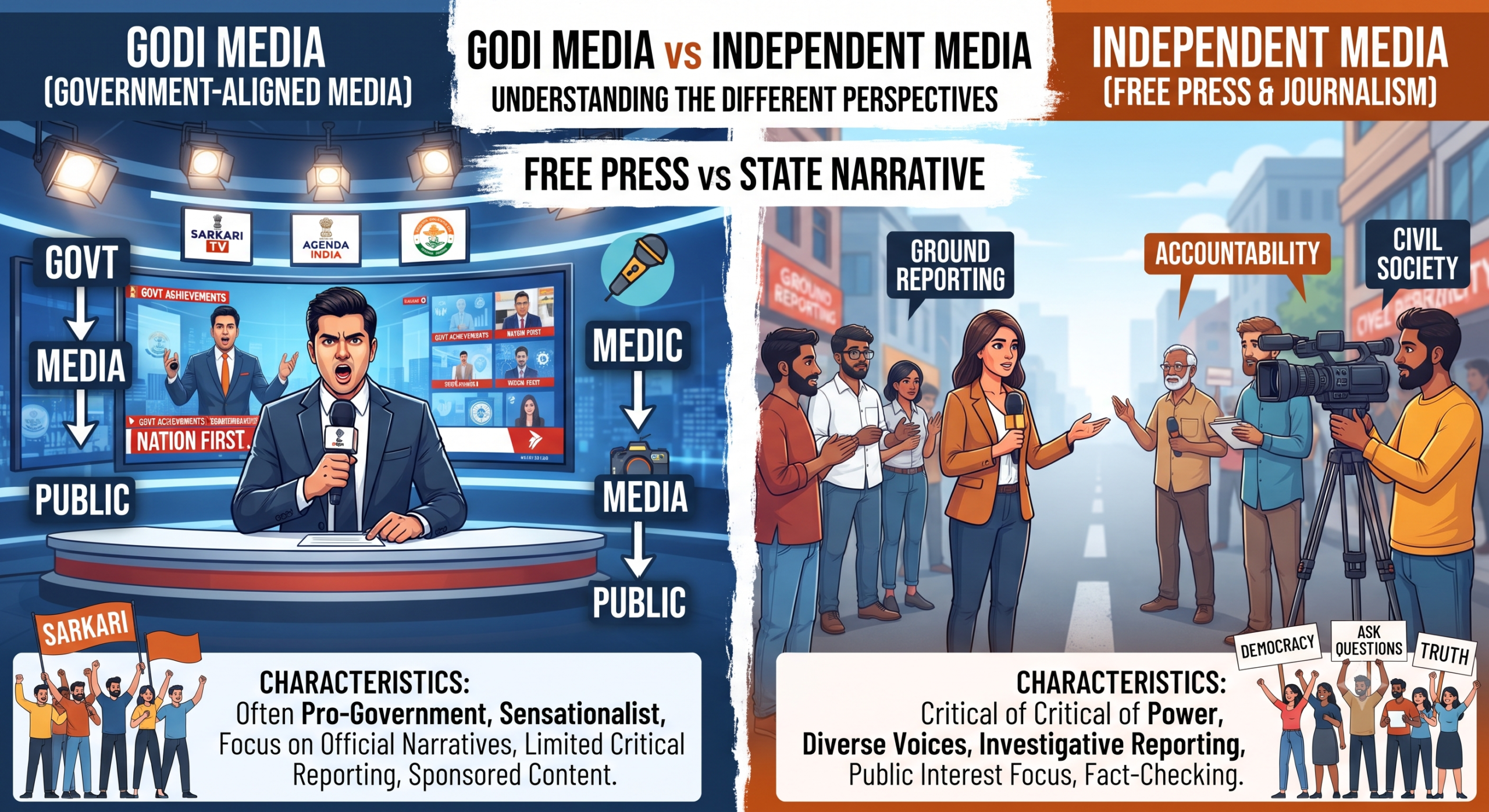
Journalists may face pressure while reporting on sensitive topics. In some situations, independent reporting can become difficult.
Fair and balanced reporting should always be encouraged.
Competition
A large number of news websites and television channels are available today.
Because of this, strong competition is faced by media organizations.
Fast reporting is important, but accuracy should never be ignored.
Decline of Print Media
Digital platforms are being preferred by many readers. Because of this, newspaper sales have been reduced in some areas.
Even so, print journalism continues to be trusted by many people because detailed and verified information is often provided.
Ethics in Journalism
Ethics are very important in journalism. Every journalist is expected to follow professional values while reporting.
Some important ethics are listed below.
- Truth should be reported.
- Facts should be verified.
- Personal opinions should be separated from news reports.
- Privacy should be respected.
- Hate speech should be avoided.
- Accurate information should be shared.
When these ethics are followed, public trust can be maintained.
The Impact of Artificial Intelligence (AI) on Journalism
Artificial Intelligence (AI) has become an important part of modern journalism.
Many tasks can now be completed with the help of AI.
For example:
- News summaries can be created.
- Grammar mistakes can be corrected.
- Headlines can be suggested.
- News trends can be identified.
- Data can be analyzed quickly.
AI has made many processes faster. However, human journalists are still needed.
Facts should always be checked by journalists before news is published. Human judgment is required to ensure fairness, accuracy, and context.
Career Opportunities in Journalism and Mass Communication
Many career options are available in journalism and mass communication.
Students can choose different fields based on their interests.
Some popular career options are:
- News Reporter
- News Anchor
- Content Writer
- Editor
- Copy Editor
- Digital Journalist
- Photojournalist
- Video Journalist
- Social Media Manager
- Public Relations Officer
- Radio Jockey
- Television Producer
- News Producer
- Media Researcher
- Communication Specialist
These careers can be found in newspapers, television channels, radio stations, digital media companies, advertising agencies, and government organizations.
Advantages of Journalism and Mass Communication
Many benefits are provided through journalism and mass communication.
Some major advantages are:
- Information is shared quickly.
- Public awareness is increased.
- Education is supported.
- Democracy is strengthened.
- Government actions are monitored.
- Public voices are represented.
- Social issues are highlighted.
- Emergency information is communicated.
Because of these benefits, journalism is considered an important part of society.
Future of Indian Journalism and Mass Communication
The future of Indian journalism is expected to be shaped by technology and changing reader habits.
Digital journalism is likely to grow further. Mobile phones, artificial intelligence, podcasts, and video content are expected to become even more popular.
Regional language journalism is also expected to grow because more people prefer reading news in their own language.
Fact-checking is likely to become more important as digital content continues to increase.
Readers are expected to demand accurate, transparent, and trustworthy reporting.
As technology continues to improve, journalism is expected to remain an important source of information for society.
Conclusion
The evolution of Indian journalism and mass communication has been influenced by history, technology, and social change. From printed newspapers during the British period to today’s digital news platforms, many developments have been seen over the years.
Journalism has been used to inform people, support democracy, raise public awareness, and encourage discussions on important issues. At the same time, new challenges such as fake news and misinformation have also emerged.
Technology has made news faster and easier to access. However, the importance of accurate reporting, ethical journalism, and fact-checking has become even greater.
In the coming years, Indian journalism and mass communication are expected to continue evolving. New technologies will be adopted, but the main purpose of journalism—to provide truthful and reliable information—will remain unchanged.
Frequently Asked Questions (FAQs)
1. What is journalism?
Journalism is the process through which news and information are collected, verified, and shared with the public.
2. What is mass communication?
Mass communication is the sharing of information with a large number of people through newspapers, television, radio, websites, social media, and other media platforms.
3. What is the importance of journalism in India?
Journalism helps people stay informed, supports democracy, increases public awareness, and highlights important social issues.
4. Who started the first newspaper in India?
Hicky’s Bengal Gazette, published in 1780, is widely regarded as the first printed newspaper in India.
5. How has digital media changed journalism?
Digital media has made news faster, easier to access, and available on mobile phones and computers. It has also increased the importance of fact-checking.
6. What are the main challenges faced by Indian journalism?
Some major challenges include fake news, misinformation, competition, pressure on journalists, and the decline of print media.
7. Why are ethics important in journalism?
Ethics help ensure that news is accurate, fair, responsible, and trustworthy.
8. How is AI being used in journalism?
AI is being used to summarize news, analyze data, suggest headlines, and improve productivity. Human oversight is still essential.
9. What career options are available in journalism and mass communication?
Career options include reporter, editor, content writer, news anchor, digital journalist, social media manager, public relations officer, and producer.
10. What is the future of Indian journalism?
The future is expected to be driven by digital platforms, AI, regional language content, and stronger fact-checking practices. For more informative articles like this, visit Postvaani.com