
Introduction
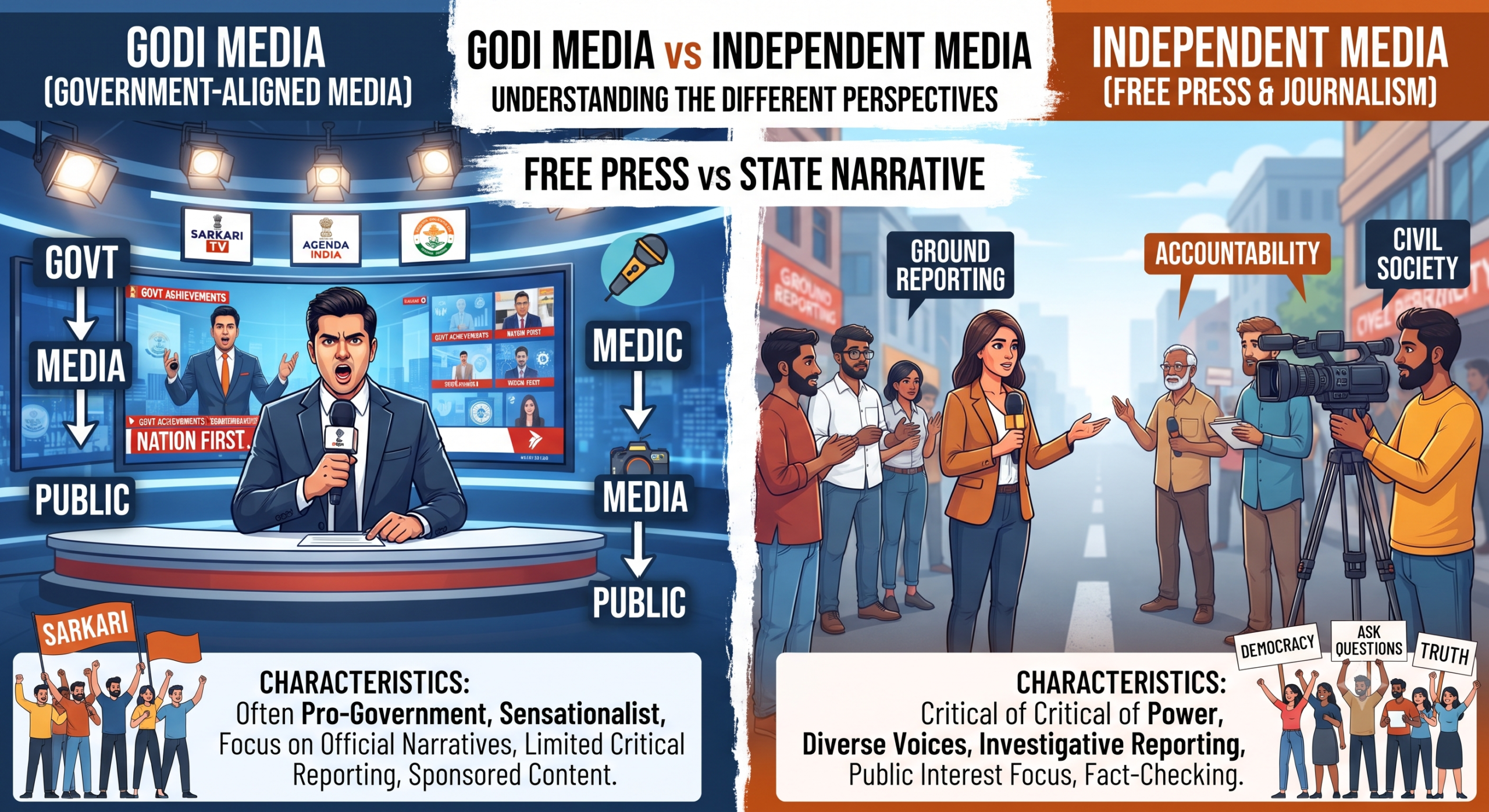
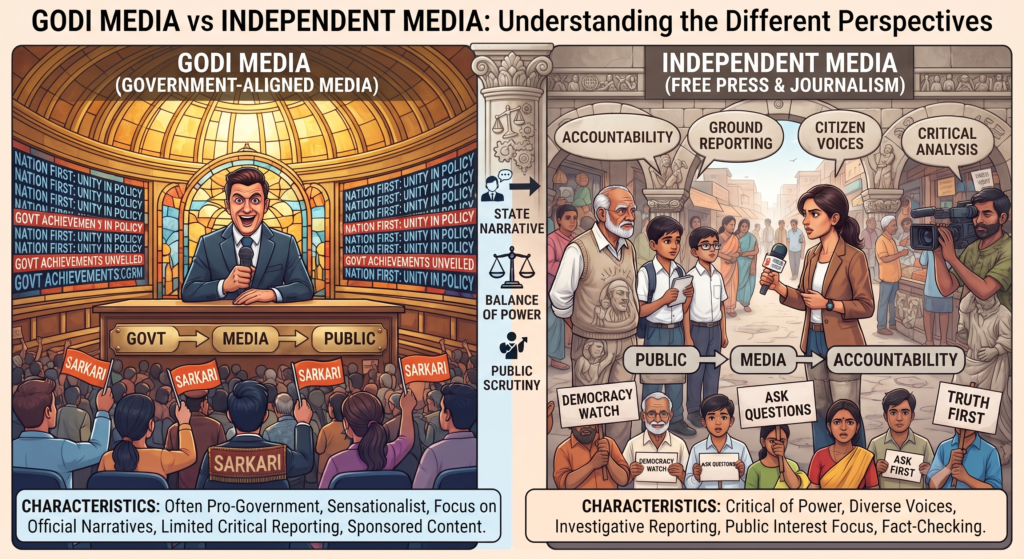
Godi Media vs Independent Media: Understanding the Different Perspectives- News is considered to be one of the most important sources of information in a democracy. Every day, millions of people are informed through television, newspapers, websites, YouTube channels, and social media platforms. Public opinion is often shaped by the news that is consumed. Because of this, the role of the media has always been considered important.
In recent years, the term “Godi Media” has been widely used in political discussions across India. At the same time, the phrase “Independent Media” has also gained attention. These two terms are often compared, especially during elections, major political events, and national debates.
Many people are confused about what these terms actually mean. Some believe that mainstream media is influenced by those in power. Others believe that independent media can also have its own opinions and biases. As a result, different viewpoints are held by different groups of people.
In this article, the meaning of both terms will be explained in simple words. Their differences, strengths, challenges, and role in society will also be discussed. A balanced understanding will be provided so that readers can form their own opinions. For more informative articles like this, visit Postvaani.com and stay updated with the latest insights and news.
What Is Godi Media?
The term “Godi Media” is a political expression that has been used by critics to describe news organizations that are believed to show favorable coverage toward the government. The word “godi” comes from a Hindi word that means “lap.” In this context, the term is used to suggest that a media outlet is seen as being too close to those in power.
It should be noted that this is a political label, not an official media category. Some people use the term frequently, while others reject it completely. Because of this, the meaning of the term often depends on personal and political opinions.
Supporters of the term argue that some news channels focus more on government achievements than on criticism. They believe that difficult questions are not always asked and that some important issues may receive less attention.
On the other hand, many journalists and media organizations reject this label. They argue that their reporting follows professional standards and that the term is often used to dismiss viewpoints that some people disagree with.
For these reasons, the term remains controversial. It continues to be debated by politicians, journalists, and the public.
What Is Independent Media?
Independent media refers to news organizations or journalists who aim to work without direct control from governments, political parties, or large corporate interests. Their goal is usually to report stories with editorial independence.
Independent media can include digital news websites, investigative journalism platforms, podcasts, newsletters, YouTube channels, and nonprofit news organizations. In many cases, these platforms are supported through subscriptions, donations, advertisements, or memberships.
Many readers choose independent media because they believe that more detailed investigations and diverse viewpoints are provided. Topics that receive less attention in mainstream media may sometimes be covered in greater depth.
However, being independent does not automatically mean that every report is completely free from bias. Like any other media organization, independent outlets can also make mistakes or present stories from particular perspectives. For this reason, every news source should be examined carefully before it is trusted completely.
Why Do Some People Support Mainstream Media?
Godi Media vs Independent Media: Understanding the Different Perspectives, Mainstream media continues to be trusted by millions of people. Large television networks and newspapers have built their reputations over many years. Experienced journalists, editors, and fact-checkers are usually employed by these organizations.
Supporters believe that several advantages are offered by mainstream media.
First, large reporting teams can be sent to cover breaking news from different parts of the country. Live updates, expert interviews, and official statements can often be provided quickly.
Second, access to government officials, international agencies, and major institutions is usually available. Because of this, important information can often be collected directly from official sources.
Third, professional editorial processes are generally followed before stories are published. Reports are often reviewed by editors, and legal checks may also be carried out.
Supporters argue that these systems help reduce mistakes and improve reliability. They also believe that criticism of governments is regularly published when facts support such reporting.
At the same time, critics believe that commercial interests, advertising revenue, and competition for television ratings can influence editorial decisions. These concerns continue to be discussed in public debates.
Why Do Some People Prefer Independent Media?
Independent media has become more popular in recent years, especially on digital platforms. Many readers and viewers believe that these platforms offer stories that are not always covered by large news organizations. As a result, independent journalism has attracted a growing audience.
Several reasons are given by people who prefer independent media.
One reason is that investigative reporting is often given more attention. Long-form reports, detailed research, and ground-level stories are frequently published. Topics such as environmental issues, local governance, public welfare, and social concerns may receive greater coverage.
Another reason is that different opinions can be found more easily. Since many independent platforms are operated by smaller teams, a wider range of voices may be heard. Readers who want alternative viewpoints often find these platforms useful.
Independent journalists are also active on YouTube, podcasts, newsletters, and social media. This allows information to be shared quickly and directly with audiences.
However, challenges are also faced by independent media. Limited financial resources can make large investigations difficult. Smaller teams may have fewer reporters and editors. In some cases, opinions may be mixed with reporting, which can make it harder for readers to separate facts from personal views.
For this reason, independent media should also be read carefully and critically.
Strengths and Challenges of Both
Both mainstream media and independent media have strengths. At the same time, both have limitations. A complete understanding can only be developed when both sides are considered fairly.
Strengths of Mainstream Media
Mainstream media usually has larger newsrooms, experienced journalists, and better resources. National and international events can often be covered quickly. Official statements and live updates are regularly provided. Since legal and editorial reviews are generally carried out before publication, many reports go through multiple levels of checking.
Challenges of Mainstream Media
Critics argue that business interests, political relationships, and competition for viewership can sometimes affect news coverage. Some stories may receive more attention than others. Editorial choices can also influence how events are presented.
Strengths of Independent Media
Independent media often focuses on detailed investigations and underreported stories. Different perspectives may be presented, and local issues can receive more attention. Many readers appreciate the diversity of opinions offered by these platforms.
Challenges of Independent Media
Independent organizations often work with smaller budgets and limited staff. Since many rely on subscriptions or donations, financial stability can be a challenge. Editorial standards can also vary from one platform to another. Readers should therefore evaluate each source on its own merits rather than assuming that every independent outlet is equally reliable.
How Can Readers Identify Media Bias?
Godi Media vs Independent Media: Understanding the Different Perspectives- Media bias is not always easy to recognize. It can appear in headlines, word choices, story selection, or the amount of attention given to certain events. Because of this, critical reading is important.
Some simple steps can help readers make informed decisions:
- Read the same news story from more than one news source.
- Separate facts from opinions.
- Check whether reliable evidence has been provided.
- Look for official reports, court documents, or verified data when possible.
- Avoid sharing news without checking its accuracy.
- Be careful with sensational headlines that are designed mainly to attract clicks.
- Consider whether important context has been included.
These habits can help readers build a more balanced understanding of current events.
The Role of Media in a Democracy
Godi Media vs Independent Media: Understanding the Different Perspectives- The media plays an important role in every democratic society. Information is shared with the public, government actions are reported, and public discussions are encouraged. Through journalism, citizens are able to learn about policies, elections, social issues, and world events.
A healthy democracy benefits from a variety of news sources. Mainstream media, regional newspapers, public broadcasters, independent journalists, and digital platforms can all contribute to public understanding. Different viewpoints allow readers to compare information and think critically.
At the same time, responsible journalism is expected from every news organization. Accuracy, fairness, transparency, and accountability are important principles, regardless of whether a platform is large or small.
Conclusion
The debate around Godi Media vs Independent Media is likely to continue as India’s media landscape evolves. Strong opinions are held on both sides, and different experiences often shape how people view the news.
The term “Godi Media” is used by some critics to describe media organizations that they believe are too supportive of the government. Others reject the label and argue that it is unfair or politically motivated. Similarly, independent media is valued by many for its editorial freedom, while others point out that independent outlets can also reflect particular viewpoints.
Rather than accepting every report without question, readers should develop the habit of comparing multiple sources, checking facts, and thinking critically. Trust should be built through evidence, transparency, and consistent reporting rather than labels alone.
In today’s fast-changing information environment, media literacy has become more important than ever. By reading responsibly and verifying information before sharing it, citizens can make better-informed decisions and contribute to healthier public discussions.
Frequently Asked Questions (FAQs)
1. What does the term “Godi Media” mean?
“Godi Media” is an informal political term used by some critics to describe media organizations that they believe provide favorable coverage of the government. It is not an official classification.
2. What is independent media?
Independent media refers to news organizations or journalists who aim to operate with editorial independence from direct government or political control.
3. Is independent media always unbiased?
No. Independent media can also have editorial viewpoints or biases. Every news source should be evaluated based on its reporting, evidence, and transparency.
4. How can I identify media bias?
Reading multiple sources, checking facts, reviewing original documents, and separating opinion from reporting can help identify possible bias.
5. Why is media literacy important?
Media literacy helps people understand how news is created, evaluate different viewpoints, recognize misinformation, and make informed decisions.
this was very insightful